
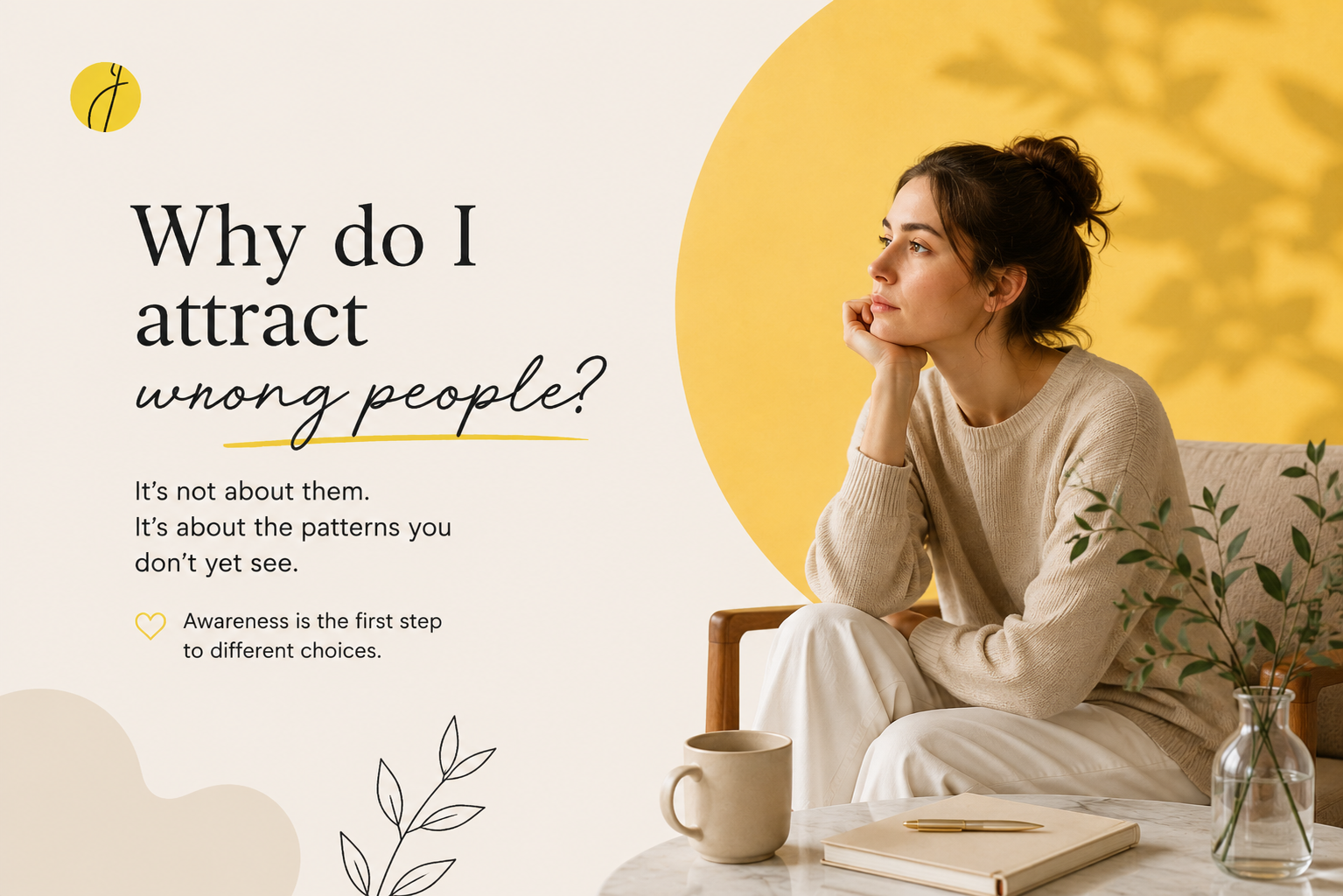
Is it my fault that I keep choosing the wrong people?

It's Sunday night. Another weekend spent on your own, while everyone around you seems to have someone. I used to really dislike Sundays.

Your mind goes, as it always does eventually,  into that topic. You're not sure why your last relationship blew up. Or why you always seem to want someone more than they want you.

Or the opposite: why does anyone who get too close suddenly feel unbearable. “Where did all the normal people go?” - you ask.  


I've been in this situation for about 10 years. And what changed everything for me wasn't a dating app algorithm or learning about my attachment style that got so over-popularised.

Keep reading as I explain this further.


What is an attachment style, and why did it become so popular?

Back in the 1950s, a British psychiatrist named John Bowlby started noticing something nobody had put into words before: the way we bond with our earliest caregivers becomes a kind of emotional blueprint. It shapes how we expect love to feel. How safe we think intimacy is? Whether the connection feels like home, or like chaos.

Decades later, that research made its way into adult relationships. And it turns out we don't leave those blueprints at childhood's door. We carry them right into every relationship we ever have. Unless, of course, we work on it.


So there are three main attachment styles:

Secure:

You feel comfortable being close to someone and comfortable with your own space. Love doesn't feel like a test you might fail.

Anxious:

You crave closeness deeply, but you're always a little braced for the moment it gets taken away. You read into silences. You need reassurance, a lot of it, and feel guilty for needing it.

Avoidant:

Intimacy makes you want to bolt. Not because you don't feel emotion, oh no.  You feel plenty. But closeness triggers something that reads as danger, and your instinct is to pull back before anyone pulls away from you first.

Nowadays, there is also an Anxiously Avoidant style, a mix between the two:

The anxious person craves closeness, which triggers the avoidant partner to pull away, which in turn intensifies the anxious partner's panic, a painful loop that many couples know all too well.

Where does common advice fall short?

The common advice on attachment theory, most famously from the book Attached, tells you to identify your style, find a secure partner and communicate your needs. 

And while that's a kind starting point, it has a fundamental flaw: it places the responsibility for your healing and happiness on someone else.

If your attachment wound makes you need twenty texts a day to feel loved, a secure partner might send texts without drama, but the wound remains exactly where it was. However, you risk losing that healthy partner, because they might realise that you still need a lot of healing to do, hence you are not what they are looking for long term.

What actually worked for me?

I was a serial dater. But I was very insecure in relationships. I was constantly checking my phone, thinking about the guy I was dating and hoping this time things would work out.

But they didn’t. Even though I was lucky to meet truly wonderful and understanding men, I would eventually scare them away.

Until I have done an enormous amount of work on myself.

I had to understand why the anxiety was there in the first place, resolve it and learn to meet enough of my own emotional needs so love and relationships could finally feel like a choice, not a salvation.

It is crucial to address the part of you that believes love is conditional, or suffocating, or always about to disappear. And you have to work on your own relationship with yourself.

Coaching has literally transformed who I am for the better, forever.

When you start to feel secure about yourself and love in general, not because your partner texts back in under three minutes, but because you've built a relationship with your own emotions, then and only then something shifts -


You stop needing someone to report to you. 

You stop feeling upset every time they want an evening alone. 

You start trusting that love doesn't have to be earned every single day from scratch.

What we all need in a partner is beautifully simple: someone who loves us and can show it. Someone supportive, caring, present, while still being their own person. Someone who lets us be ours. A relationship rooted in mutual respect, genuine affection, and the grace to let each other be individuals, together.

That's the whole thing.

And that security is a skill, not a personality trait

So the next time you're sitting alone on a Sunday night, wondering why it never quite works, maybe the question isn't, "Why do I keep attracting the wrong people?" Maybe it's: what would it feel like to stop needing the right person to make me feel good?

That's where it begins.

Not with them. 

With you!


In my “Love Made Easy” Online Coaching Program, we make love life fun and enjoyable again!

With love & solidarity,

Jelena

Read More
Neuroscience & Psychology Jelena Lihhatsova Neuroscience & Psychology Jelena Lihhatsova

"Your character is your limitation (wait, what?)"

Discover why behavioral flexibility matters more than strong character. Learn how strong character limits your growth and how to increase your range to stop anxious attachment, people pleasing or self-doubt.

My close friend Ksenia gave me an amazing compliment. She said I'm "like an open book written in an unknown language."

I laughed, of course. I knew exactly what she meant.

Even when she thinks she knows me well, I surprise her in ways she doesn't expect. I'm unpredictable. And that I am.

For example: I hate violence, avoid movies that show it, and yet one of my favorite games is Mortal Kombat. (I have no problem kicking ass as Noob Saibot, thank you very much.)

I'm deeply social and love being around people, yet the idea of going to a pub with coworkers on a Friday just to sit for hours? Draining.

The list of my seemingly opposite preferences is long for me.

This contradiction brings me to something I heard years ago that shifted how I see personal growth:

Your character is your limitation.

I know, I know. We all grew up hearing that having a strong character is a virtue. That not having one makes you a 🐈. I wanted an explanation too!

So where does this idea come from?

This principle is borrowed from cybernetics and systems theory, which states: The element with the greatest flexibility controls the system.

In simpler terms? Whoever has more behavioral flexibility has more influence and more success.

But what does this have to do with character?

I like to think of character the way Lao Tzu did:

"Watch your thoughts, they become your words; watch your words, they become your actions; watch your actions, they become your habits; watch your habits, they become your character; watch your character, it becomes your destiny."

This beautifully describes how thinking the same thoughts makes you act the same way (habit), and how that creates certain inflexibility (character) that, in turn, creates your results in life.

In practice you say things like:

  • "I can't just leave, I'm not that kind of person." (Anxious Attachment)

  • "I can't speak up, I'm too shy." (Self-Doubt)

  • "I can’t just say No. That’s rude" (People Pleasing)

Every "excuse" is a signal of lost flexibility. A fixation on a set character.

Think about it:

In relationships, the partner who can regulate their nervous system, shift perspective, soften their stance, and adjust their communication style will influence the dynamic more than the partner who clings to being right.

In leadership, the manager who can move fluidly between firmness and empathy, structure and openness, will outperform the one who hides behind a strictly defined character.

In life, the person who can adapt their response by having control of it, rather than defaulting to the same pattern every time, has more freedom and hence options.

A strong character may look impressive from the outside.

But true strength is the ability to choose your response.

True power is having a wide range of behaviors available to you and the ability to select the right one for the moment.

The role of therapy or coaching, then, is not to change who you are.

It's to increase your range.

To widen your behavioral options.

To enrich you.

To help you outgrow old strategies that no longer serve the life you want to build.

And I’ll leave you with these two questions:

What are the things you feel most inflexible about?

What results does that inflexibility bring into your life?

With Love & Solidarity,

Jelena

www.coachingwithjelena.com

Read More

“Foundations of anxiety, self-doubt, and modern human suffering”

Anxiety, overthinking, self-doubt, and impostor syndrome are not signs that something is wrong with you. They are signs that your brain is doing exactly what it evolved to do - just in a world it was not originally designed for.

Let’s talk about negativity bias, where it comes from, and why real change requires more than understanding.

Remember, the brain's only job is to keep you alive, happy or not, is irrelevant for the brain.

If you are a human on this planet, chances are that you know very well what anxiety, self-doubt, and overthinking feel like. And If you’ve ever thought, “Logically, I know everything is fine… so why do I feel this way?” - this article is for you.

Anxiety, overthinking, self-doubt, and impostor syndrome are not signs that something is wrong with you. They are signs that your brain is doing exactly what it evolved to do - just in a world it was not originally designed for.

Let’s talk about negativity bias, where it comes from, and why real change requires more than understanding.

Why anxiety feels real when nothing is wrong?

To answer this highly popular question, let me introduce the brain’s Negativity Bias. Negativity Bias is our brain’s tendency to:

  • Notice negative information faster

  • Remember it longer

  • Give it more emotional weight than neutral or positive information.

Sounds kinda daunting, right? But let me explain what’s behind it according to evolutionary neuroscience.

For ~200,000 years, the human brain evolved in environments where:

  • Missing a real threat = death

  • Being exiled from the tribe = death

  • Being in a new environment = high chances of death

So the brain learned a simple rule:

“It’s better to assume danger and be wrong than to assume safety and be dead.”

This is why:

One criticism outweighs ten compliments

One awkward interaction replays all night

One uncertainty triggers anxiety, even when life is objectively okay

In simple terms, we can look at it in the following way:

Your brain is not asking: “Is this likely?”. It’s asking: “Could this hurt me?”

The brain structure involved in this process, called the amygdala, scans and reacts to rejection, uncertainty, social tension, loss of control, conflict, and challenging conversations as if they were a threat to your physical well-being. Because a looong time ago, that meant being exiled from your tribe and potentially being eaten.

Remember, the brain's only job is to keep you alive, happy or not, is irrelevant for the brain.

This is why anxiety appears without logic.

Then we also have the hippocampus responsible for memory + pattern storage and it stores emotionally charged memories. Negative experiences get encoded faster and deeper. This explains why one painful breakup can shape relationship beliefs for decades.

And of course, let’s not forget about the Prefrontal cortex (PFC) responsible for reasoning & regulation. The caveat with this guy, though, is that it switches on in a calm state, but under stress, the PFC goes partially offline.

This is why telling yourself to “calm down” when you have anxiety doesn’t work.

You may think, “Modern threats are rarely physical.” True. But your nervous system is still hardwired to see the above as real danger.

Conflict with someone turns into “They do not like me anymore, which means, I will be isolated, being isolated means danger, and that I will be eaten by a lion”.

As silly as this sounds, this is very close to what the biased brain that evolved through thousands of years of literally surviving actually thinks.

So it releases: adrenaline & cortisol, and as a result, you feel anxiety, rumination, overthinking or hypervigilance.

Where Therapy Often Ends and Coaching Begins

Therapy is invaluable. Especially for trauma processing, safety, and healing the past.

But many people reach a point where they say:

“I understand why I’m like this.”

“I’ve processed my childhood.”

“I know this isn’t rational.”

And yet…

Their body still reacts.

This is because insight doesn’t automatically rewire the nervous system.

Knowing why you’re anxious doesn’t teach your system what safety feels like now.

Coaching works in the present-moment loop where patterns actually run.

It helps you:

  • Notice beliefs as they activate in real time

  • Interrupt the stress response before it hijacks your day

  • Rebuild trust between your mind and body

  • Practice regulation while living your real life

This is how rewiring happens. And that’s exactly where coaching lives.

With Love & Solidarity,

Jelena

Read More

Can You Really Let Go of Your Fears?

“Just let it go!”
If you’ve ever heard that phrase… you probably know the rage that rises when someone says it. As if letting go is a button. As if you haven’t already tried.

Just Let It Go! and other pointless advise

“Let it go!”


If you’ve ever heard that phrase… you probably know the rage that rises when someone says it. As if letting go is a button. As if you haven’t already tried.

For decades, my life looked like a movie I would not have auditioned for.

My fiancé disappeared.

Then he ended up in prison.

I spent four years in excruciating pain waiting for surgery, practically living in hospitals.

Someone I loved drowned at 31.

I battled insomnia so brutal that I developed PTSD, depression and anxiety from it.

I was fired, misjudged, mislabeled, misunderstood and misdiagnosed. 

All before even turning 35.

For a long time, I carried my pain like proof that life was hard, that I was fragile, that the universe somehow owed me. And yes, I pitied myself. Yes, some days I felt like a victim. And honestly? That was human.

Later, I learned I have some neorodivergent tendencies, but definitely High Sensitivity — which means I feel everything deeply, process all information intensely, and perhaps a little too fully. That notion brought better understanding, but still, no healing.

Can you really let go of fear and old pain?

Or does it live in you forever?

Here’s what I know after trying CBT, therapy, hypnotherapy, breathwork, meditation, acupuncture, reiki, somatic healing, sound baths (I research like a scientist 😅), coaching, thought-work… all of it.

You can let go of your pain and fear.
And you must.
Because if you don’t, it doesn’t just stay inside you - it spreads.

Unprocessed pain sneaks into your relationships. It weighs on your health. It shapes your choices. It distances you from the people you love. It becomes part of your identity, even when you desperately want to grow past it.

But doing it alone? Nah. I don’t think I could have. And I don’t think most people can.

I do a combination of things: I meditate, I journal, I sit with my feelings in silence and allow myself to feel whatever comes. I had a lot of pittiness, sadness, fear. I allowed it because I needed to know what I was working with. And then I brought this in conversations with my coach.

Even now, as a certified coach myself who helps others rebuild trust and confidence after heartbreak and loss, I still work with a coach. Because knowing the path is not the same as walking it. I have a guide I trust and it makes me a better guide to others.

That’s me. You might be different.

If one hypnotherapy session cures you — please send me their number, because I’m jealous 😂

But here’s what I want you to remember: Healing is not a standalone event; it is a relationship with yourself that takes time to build.

If anything in this post reflected even a small part of your story, I’d genuinely love to hear from you. Not to sell you anything. Just to connect. Healing is not meant to happen in isolation.

With love & solidarity,

Jelena

Read More
Jelena Lihhatsova Jelena Lihhatsova

Ireland, love, and a decision that changed everything

A decision that changed my life and made me who I was always supposed to become

Jelena sitting in a cafe in Dublin with a coffee mug

It takes me back to Christmas 2009,

when I first set foot on Irish soil — unaware that I was stepping into my own kind of Narnia

Hi lovely,

This week I’m visiting my second home - Ireland. 

This post is dedicated to this emerald island, but it’s not just about a place; rather, it is about love, loss, and the kind of relationship that changes you forever. The kind that breaks you open just enough to let the light in.

I came to Ireland years and years ago, with someone who is no longer in this world but who shaped mine in ways I could never have imagined. I became Irish, for goodness’ sake, something that would have never happened without him.

As I walk the familiar streets of Dublin, I feel his presence everywhere. It takes me back to Christmas 2009, when I first set foot on Irish soil — unaware that I was stepping into my own kind of Narnia, full of charm, magic, and life-changing moments.

He was the reason I got on that plane. He was the one who showed me love that was beautiful and difficult and worth every heartbeat. And even though he’s gone, a part of me still wishes to talk, to laugh, to say thank you for turning my life upside down and forcing me to choose between breaking and rising. 

I share this because I know many of you carry a place inside that feels like that - a space where nothing grows, yet somehow everything does.

After a loss (either by choice or by fate), we want to protect ourselves from the pain, but in doing so, we also prevent joy, new love, and new opportunities. 

That chapter, that person, even though we parted ways in love before we parted ways in dimensions - he opened the door for me, inspired me, to embark on a journey to a different life. A life to be more. More interesting, more wise, more loving, more courageous, more feeling, just more. 

And it’s what led me to the work I do now: standing beside women who also want to heal, love again, and live more fully after life has changed them.

And if you knew me back in 2016, I understand how surprised you are. Back then, I also didn’t think a better way was actually possible. And yet, here I am.

That’s what healing is -  allowing the experiences of the past to grow something new within you.

“In the shelter of each other, we live.” — Irish proverb


With love & solidarity,
Jelena
https://www.coachingwithjelena.com/love-without-fear

Read More