
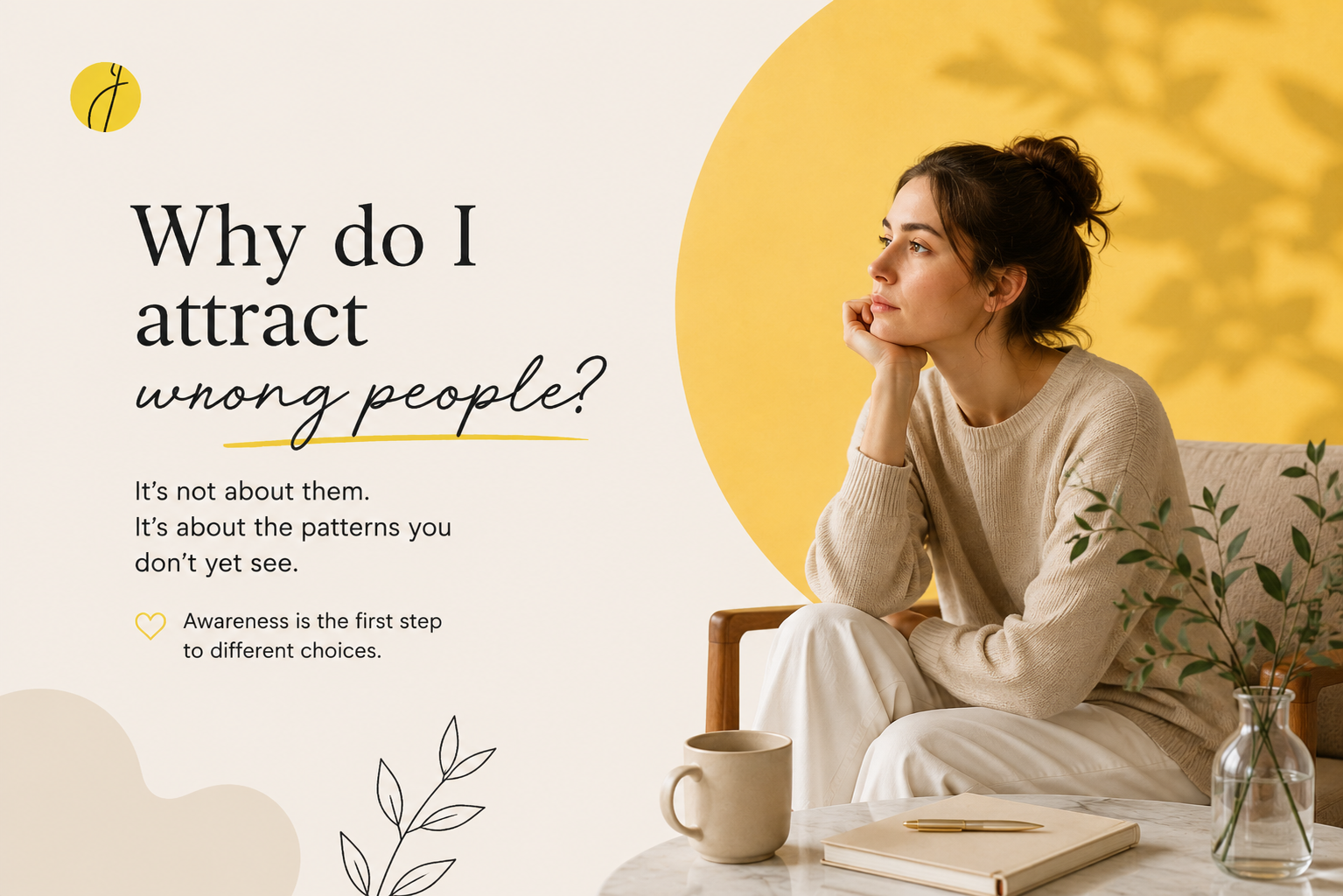
Is it my fault that I keep choosing the wrong people?
It's Sunday night. Another weekend spent on your own, while everyone around you seems to have someone. I used to really dislike Sundays.
Your mind goes, as it always does eventually, into that topic. You're not sure why your last relationship blew up. Or why you always seem to want someone more than they want you.
Or the opposite: why does anyone who get too close suddenly feel unbearable. “Where did all the normal people go?” - you ask.
I've been in this situation for about 10 years. And what changed everything for me wasn't a dating app algorithm or learning about my attachment style that got so over-popularised.
Keep reading as I explain this further.
What is an attachment style, and why did it become so popular?
Back in the 1950s, a British psychiatrist named John Bowlby started noticing something nobody had put into words before: the way we bond with our earliest caregivers becomes a kind of emotional blueprint. It shapes how we expect love to feel. How safe we think intimacy is? Whether the connection feels like home, or like chaos.
Decades later, that research made its way into adult relationships. And it turns out we don't leave those blueprints at childhood's door. We carry them right into every relationship we ever have. Unless, of course, we work on it.
So there are three main attachment styles:
Secure:
You feel comfortable being close to someone and comfortable with your own space. Love doesn't feel like a test you might fail.
Anxious:
You crave closeness deeply, but you're always a little braced for the moment it gets taken away. You read into silences. You need reassurance, a lot of it, and feel guilty for needing it.
Avoidant:
Intimacy makes you want to bolt. Not because you don't feel emotion, oh no. You feel plenty. But closeness triggers something that reads as danger, and your instinct is to pull back before anyone pulls away from you first.
Nowadays, there is also an Anxiously Avoidant style, a mix between the two:
The anxious person craves closeness, which triggers the avoidant partner to pull away, which in turn intensifies the anxious partner's panic, a painful loop that many couples know all too well.
Where does common advice fall short?
The common advice on attachment theory, most famously from the book Attached, tells you to identify your style, find a secure partner and communicate your needs.
And while that's a kind starting point, it has a fundamental flaw: it places the responsibility for your healing and happiness on someone else.
If your attachment wound makes you need twenty texts a day to feel loved, a secure partner might send texts without drama, but the wound remains exactly where it was. However, you risk losing that healthy partner, because they might realise that you still need a lot of healing to do, hence you are not what they are looking for long term.
What actually worked for me?
I was a serial dater. But I was very insecure in relationships. I was constantly checking my phone, thinking about the guy I was dating and hoping this time things would work out.
But they didn’t. Even though I was lucky to meet truly wonderful and understanding men, I would eventually scare them away.
Until I have done an enormous amount of work on myself.
I had to understand why the anxiety was there in the first place, resolve it and learn to meet enough of my own emotional needs so love and relationships could finally feel like a choice, not a salvation.
It is crucial to address the part of you that believes love is conditional, or suffocating, or always about to disappear. And you have to work on your own relationship with yourself.
Coaching has literally transformed who I am for the better, forever.
When you start to feel secure about yourself and love in general, not because your partner texts back in under three minutes, but because you've built a relationship with your own emotions, then and only then something shifts -
You stop needing someone to report to you.
You stop feeling upset every time they want an evening alone.
You start trusting that love doesn't have to be earned every single day from scratch.
What we all need in a partner is beautifully simple: someone who loves us and can show it. Someone supportive, caring, present, while still being their own person. Someone who lets us be ours. A relationship rooted in mutual respect, genuine affection, and the grace to let each other be individuals, together.
That's the whole thing.
And that security is a skill, not a personality trait
So the next time you're sitting alone on a Sunday night, wondering why it never quite works, maybe the question isn't, "Why do I keep attracting the wrong people?" Maybe it's: what would it feel like to stop needing the right person to make me feel good?
That's where it begins.
Not with them.
With you!
In my “Love Made Easy” Online Coaching Program, we make love life fun and enjoyable again!
With love & solidarity,
Jelena
When Your Career Thrives, but You Don’t
For Women Who’re Winning at Work and Struggling Inside
Recently, I attended a Women’s Circle event organised by Women In Tech. It was brilliant! We talked business, love, health yet one theme kept coming up:
High-functioning anxiety in high-functioning women.
It’s when you lead, deliver, manage, support everyone…
while internally battling chronic stress, overthinking, emotional exhaustion, imposter syndrome and a constant need to prove yourself.
You look “fine,” but you don't feel fine.
And I know this world far too well.
I trained & coached wonderful teams, worked with excellent managers, met big CEOs, was hired by Irish musicians, designers, published in newspapers & magazines, while in my personal life, I was insecure and crippling.
My emotions ran the show.
My body was breaking down long before I admitted anything was wrong.
When your inner world is ruled by fear, your brain minimises you and your achievements. So despite success on the outside, you remain feeling small.
That’s what high-functioning anxiety does to you, it keeps you performing and shrinking at the same time. I learned to cry in the morning, perform all day, fall apart at night and repeat.
And somehow, despite insomnia, anxiety, and emotional burnout… I still kept delivering and even being promoted. Because honestly? I loved what I do.
But inside, all the unaddressed and unchanged patterns were dissociating me from my own life.
Talking therapies helped me understand my pain. But they didn’t shift me into safety in the present.
That came later, through deeper identity work, nervous system science, and the kind of support I now offer.
So today, I want to give you a simple but powerful exercise to reconnect with yourself and get real:
1. Write down 5 achievements you’re genuinely proud of.
2. For each, remember how you actually felt at the time.
Rate it from 1–10 (1 = numb, 10 = deeply fulfilled).
3. If any score is below 10 or 9, ask:
“What made it hard to fully receive this?”
Write down the first sentence that comes up, without censoring it.
This reveals your internal limits: the beliefs that block joy, self-worth beliefs, dissociating anxiety etc.
4. Now write 5 things you want to achieve next, in work and in life.
5. Circle the ONE that would make the biggest difference right now.
And finally:
6. Ask - what identity would I need to embody to make this possible?
7. What are you responsible for here?
Because real success is never just strategy.
It’s identity.
It’s safety.
It’s a regulated nervous system.
It’s an inner world that CAN HANDLE the life you’re building.
If this resonates with you, sign up for my blog and newsletter below. I’d love to have you💛
With love & solidarity,
Jelena